
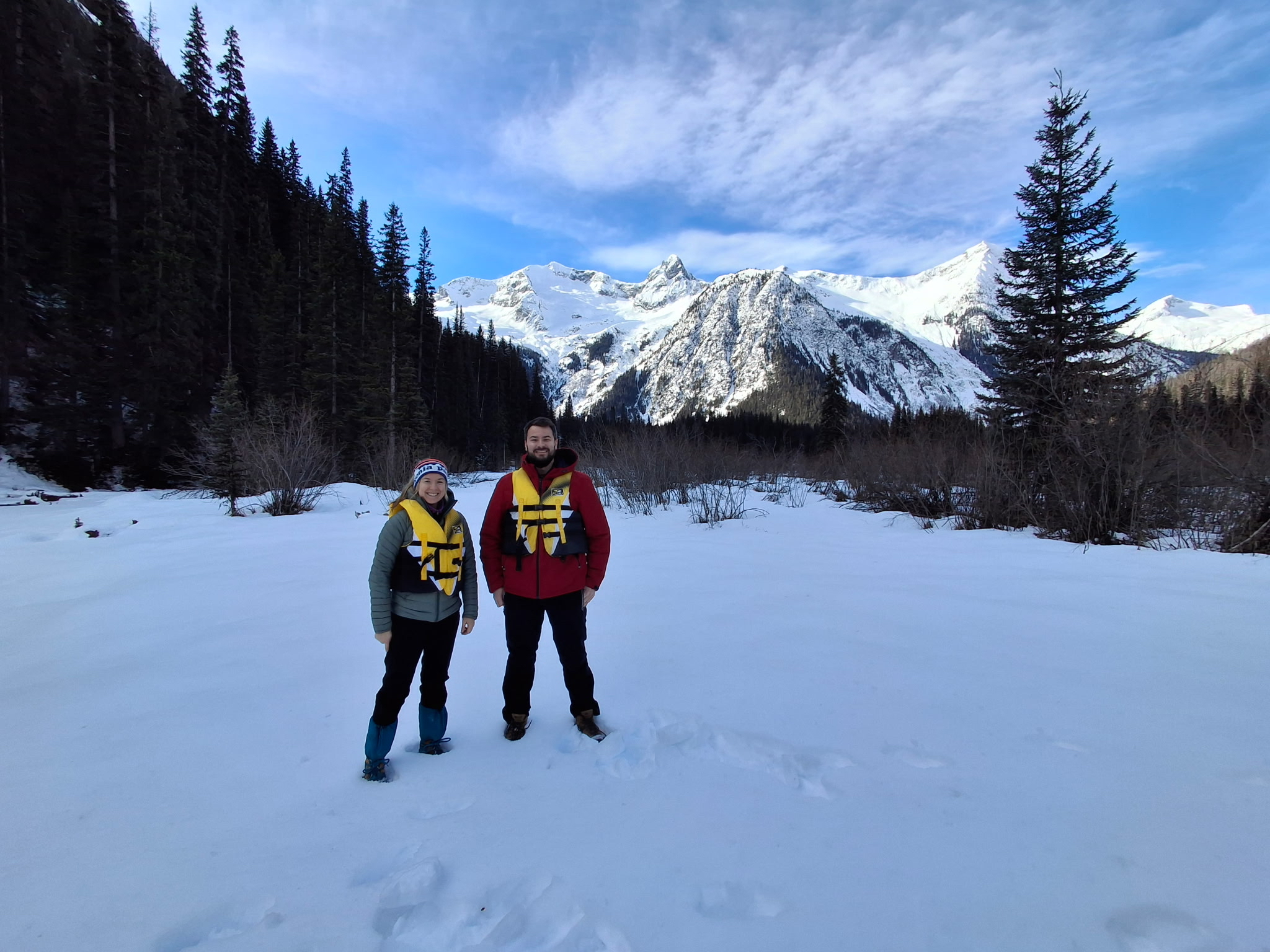
The Stein Valley is culturally important to the Nlaka’pamux who have used it for fishing salmon and trout, and as a spiritual and cultural site with rock paintings and writings present along the valley path. The 60 km river stems from headwaters fed by glaciers into Stein Lake before flowing through the remainder of the valley.
Accessed by a hiking trail, travel through the valley is limited and it remains relatively undisturbed from direct human impact. However, climate change causing increased fire events is a concern, as many large fires have burned the forests within the valley, raising concerns of erosion and river blockages in the upper, largely inaccessible reaches.
Through the Department of Fisheries and Ocean’s (DFO’s) Indigenous Habitat Participation Program (IHPP), the Nlaka’pamux Nation Tribal Council (NNTC) received funding to assess the health of the Stein River from a fisheries perspective. On March 2nd, 2026, a helicopter from Contour Helicopters was contracted to fly Kevin Duncan, the Natural Resources Lead from NNTC, and two biologists (Reid Bryshun and Breanne McAmmond) from A.E.W. Limited Partnership (A.E.W.) up to the headwaters of the Stein River.
The flight had three objectives: (1) Collect water samples from several spots along the river to verify water quality is within acceptable levels. (2) Collect eDNA samples (traces of animals in the water) to determine whether salmon and trout can migrate through entire length of the Stein River. (3) Fly low over the Stein River and see if any potential blockages to fish passage are found. The flight was also a test of in-development mapping technology called VoxVision, which captured photos of the flight from a camera mounted at the front of the helicopter.
The crew lifted off from Boothroyd airfield, flying up the Nahatlatch River, then up the Kwoiek Valley and over Skihist Mountain to the headwaters of the Stein River. Stein Lake was partially thawed, so the helicopter landed on the shore of both the outflow and the inflow of the lake so samples could be collected by the crew. Kevin Duncan gave a prayer of thanks before the work began.
From there, the helicopter flew 500 ft above the Stein River, giving the crew a clear view of the river below. They found two blockages in the upper reaches, both caused by log jams on the river one much larger than the other and potentially impeding fish movement. The crew set down one final time below the log jams to collect samples to assess whether fish can make it up to that point.
The flight was followed up by a hike on March 5th, 2026, by two biologists from A.E.W., Reid Bryshun and Jordan Seo. They hiked 4.5 km up the lower reaches Stein River to just past the Devil’s Stair Camp, collecting additional water and eDNA samples for analysis.
While results of the eDNA analysis are still pending, the water quality sample results show that there are no exceedances of any parameters within the water that would affect salmon or humans. This shows that despite all the impacts people have had in the area, the preserved and protected nature of the Stein means it remains undiminished and almost as unaffected as a river system can be in this anthropological age.